


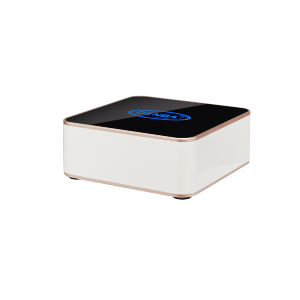
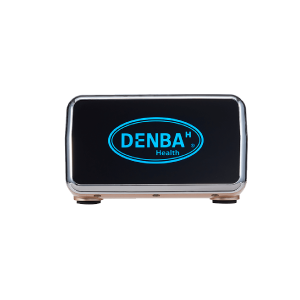

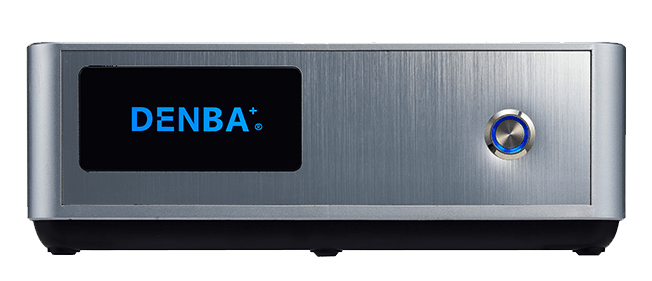
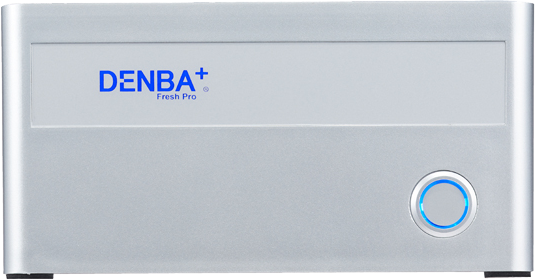
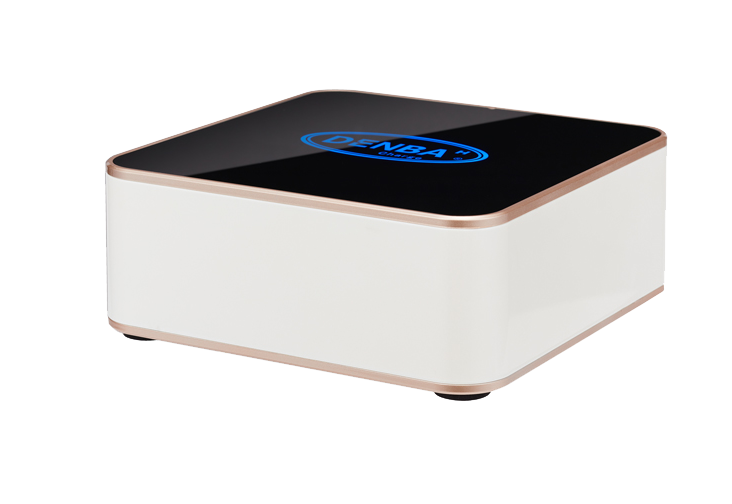
DENBA is a next-generation freshness-preservation technology that keeps the water molecules in food active, holding produce at its peak. You fit a compact unit to the refrigerator or freezer you already use, and the DENBA effect works throughout that space. Premium fruit such as grapes and Shine Muscat stays juicy and good two months on. Processors supplying meat to supermarkets report drip loss cut by up to 95% when thawing meat and fish. Even an ordinary freezer can freeze without breaking down cell structure. DENBA is now being built into domestic refrigerators, commercial refrigerators, delivery trucks and shipping containers around the world.
Unstable weather driven by a warming climate, damage from typhoons and heavy rain, and demand that became impossible to forecast during the COVID-19 pandemic have all put real pressure on people who work with food.
At the same time, the Sustainable Development Goals have become a shared international agenda, and businesses are expected to play their part.
Across the food chain - from growers to retailers to restaurants - DENBA works on the same set of problems: raising the value of a shipment by controlling when it goes out, steadying unit prices by easing oversupply, opening up more distant markets, holding unit price by extending the window in which produce is at its best, and reducing food loss.
High-quality freezing that puts less stress on the food
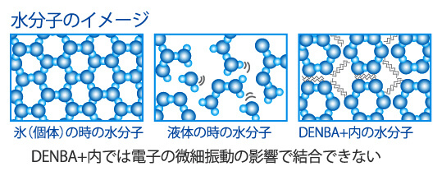
No freezing down to -4°C, and once freezing does begin, it happens faster than in conventional freezing.
Freezing food while DENBA technology is applied means you can freeze it without rupturing cells, with its freshness held.
In other words, without a -50 to -60°C blast freezer, your existing freezer at -18 to -25°C can freeze while holding freshness.
Point 1
Results close to blast freezing, in an ordinary freezer
What it does
As food freezes, it passes through a temperature band known as the zone of maximum ice crystal formation (-1°C to -5°C). As the name suggests, this is where the water in the food turns to ice most readily. There is more detail on this below.
Water expands to about 1.1 times its volume when it turns to ice, and that expansion is thought to be what ruptures cell membranes.
Blast freezing solves this by pushing the food through that band as quickly as possible. DENBA takes a different route: by resonating the water molecules and keeping them active, it creates an environment in which freezing is resisted down to -4°C, holding back ice formation in the critical band. The food is frozen with as little stress on it as possible, which is what produces the quality difference.
The zone of maximum ice crystal formation (-1°C to -5°C)
When food is frozen, its temperature falls quickly until it reaches the freezing point below 0°C. From there down to -5°C the fall becomes extremely slow, because most of the cooling is going into removing the latent heat of fusion (about 80 kcal per kg of water). That band is what is called the zone of maximum ice crystal formation.
Point 2
Freezing that leaves cells intact
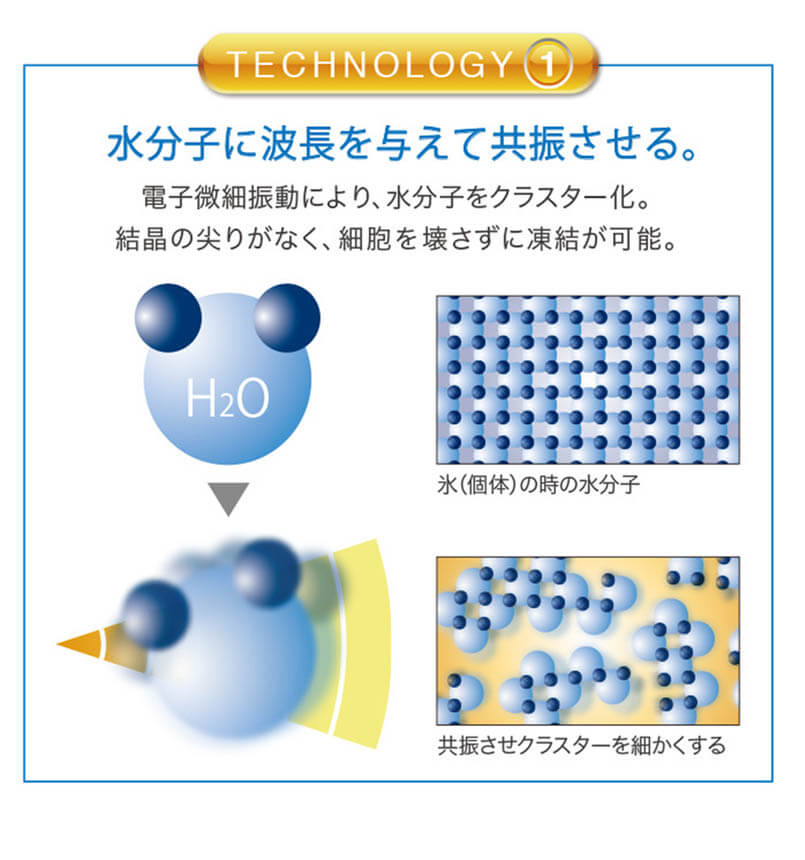
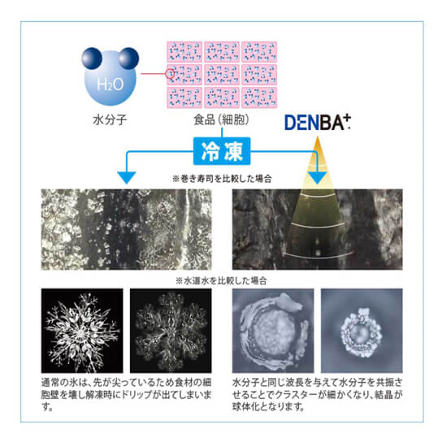
A comparison of ice crystals formed during freezing. Ordinary ice crystals are sharply pointed, which breaks cell walls and causes drip loss on thawing. When DENBA is applied, a wavelength matched to the water molecules keeps them resonating, the clusters become finer, and the crystals form closer to spheres - so the food is not damaged.
Point 3
Lower energy use and lower CO₂*
*compared with a -60°C blast freezer
A case from the field
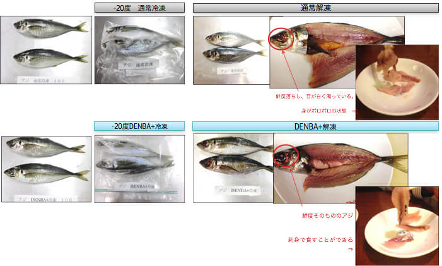
Oily fish spoils readily, so horse mackerel that has been slow-frozen and thawed cannot normally be served as sashimi.
This was the first case anywhere of horse mackerel frozen with DENBA at ordinary slow-freezing temperatures (-18 to -25°C) coming out of the thaw fresh enough to serve as sashimi.
From the restaurant owner and head chef
You can tell how fresh the fish is the moment the knife goes in. I still can't quite believe you can slow-freeze horse mackerel and thaw it like this.

 info@denba.jp