


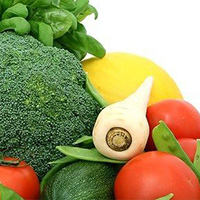
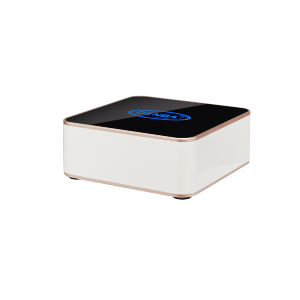
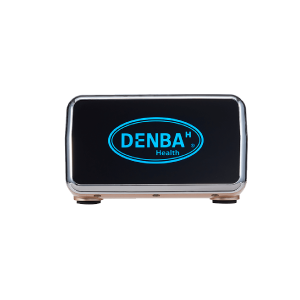
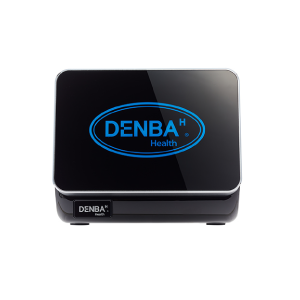
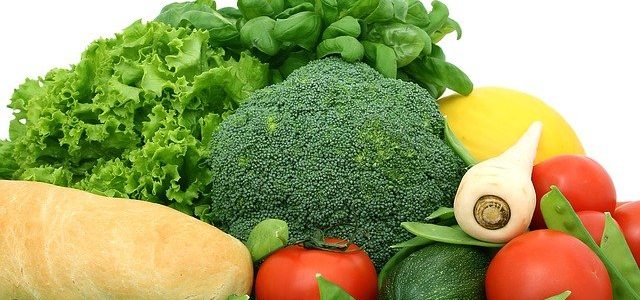
DENBA is a next-generation freshness-preservation technology that keeps the water molecules in food active, holding produce at its peak. You fit a compact unit to the refrigerator or freezer you already use, and the DENBA effect works throughout that space. Premium fruit such as grapes and Shine Muscat stays juicy and good two months on. Processors supplying meat to supermarkets report drip loss cut by up to 95% when thawing meat and fish. Even an ordinary freezer can freeze without breaking down cell structure. DENBA is now being built into domestic refrigerators, commercial refrigerators, delivery trucks and shipping containers around the world.
Unstable weather driven by a warming climate, damage from typhoons and heavy rain, and demand that became impossible to forecast during the COVID-19 pandemic have all put real pressure on people who work with food.
At the same time, the Sustainable Development Goals have become a shared international agenda, and businesses are expected to play their part.
Across the food chain - from growers to retailers to restaurants - DENBA works on the same set of problems: raising the value of a shipment by controlling when it goes out, steadying unit prices by easing oversupply, opening up more distant markets, holding unit price by extending the window in which produce is at its best, and reducing food loss.
How DENBA is being used
COVID-19 changed the restaurant business considerably.
Since then, the enquiry we hear most often comes from restaurants whose footfall has not recovered, who can no longer sell the volume they used to buy within the same window:"we're throwing more away" and "we froze what was left over and the quality dropped".
DENBA addresses exactly this, through freshness preservation, high-quality freezing and low-drip thawing. If this is your situation, please get in touch.
Freshness-preservation technology aimed at eliminating food loss
DENBA+ creates an electrostatic field inside the refrigerator and emits its own wavelength, producing a chilled environment in which the water in the food does not turn solid - does not freeze - even between 0°C and -4°C. Because the space is held in that electrostatic state, oxidation is slowed and bacterial growth is inhibited. That is what gives DENBA+ an environment where food both stays fresh and ages well.
Point 1
Sub-zero without freezing
The whole interior becomes an electrostatic space, giving a chilled environment that does not freeze down to -4°C. Food can be held far longer while still fresh.
What it does
Because it doesn't freeze, the food goes on ageing - and the flavour deepens.
Bacterial growth is inhibited, to roughly one thirtieth of the usual rate.*
Point 2
Slowing oxidation to hold freshness
Electronic energy is formed in the space, and the resulting reduction environment slows oxidation of the food, holding its freshness.
What it does
Keeping the cells of the food active is what preserves its freshness.
Point 3
Inhibiting bacterial growth
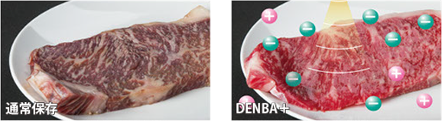
A comparison after two weeks in refrigerated storage. The conventionally stored beef has discoloured throughout, from the fat to the lean, and smells of spoilage. The beef stored with DENBA shows no discolouration and has held its freshness.
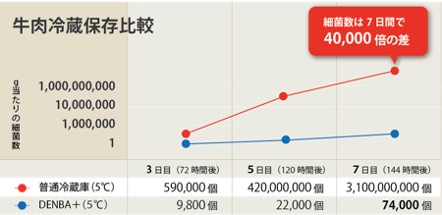
* Compared with a conventional refrigerator. Testing by the Japan Food Research Laboratories.
Freshness preservation - what you get, in summary
01 Less drip, so less flavour lost - and the food goes on ageing, building amino acids and depth
Because the food is held chilled rather than frozen, drip - and the flavour that goes with it - is kept in, while the food continues to age and build amino acids.
It works well where the aim is to bring more sweetness out of fruit.
02 Thawed food holds up in storage - less shrinkage, less slackening
Thawed ingredients kept in storage are less prone to shrinking, going slack, taking on colour or developing off odours.
03 Suited to storing ingredients where odour transfer is a concern
Different ingredients can be stored together with far less odour carrying from one to another.
04 Holds the natural colour of fresh ingredients
The reduction environment slows the oxidation that causes discolouration.
05 Ideal for holding food after plating or prep, keeping it moist and bright
Sashimi cut and plated in advance, or meat sliced ahead of service, keeps its moisture and colour until it goes out. There is no discolouration, and it is less prone to sticking, drying out or losing its shape.
Comparing the DENBA freshness-preservation range
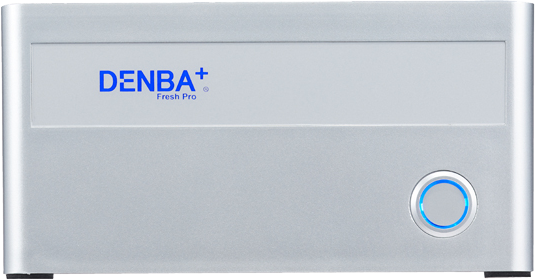
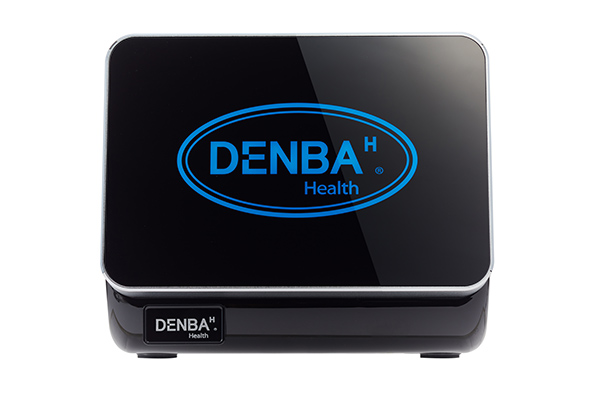
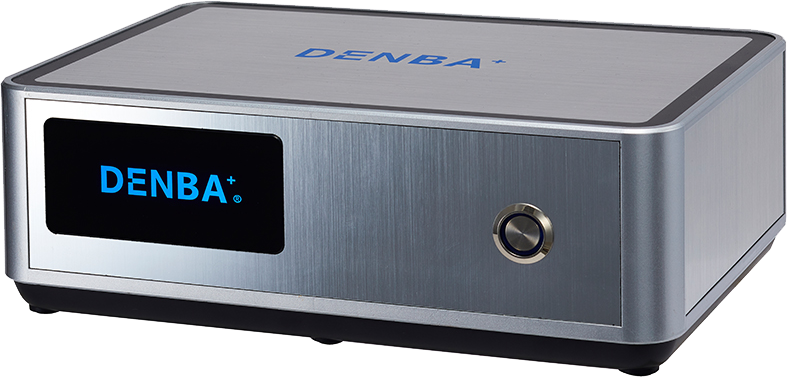
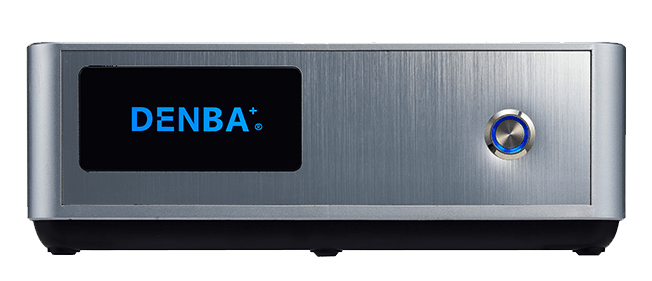
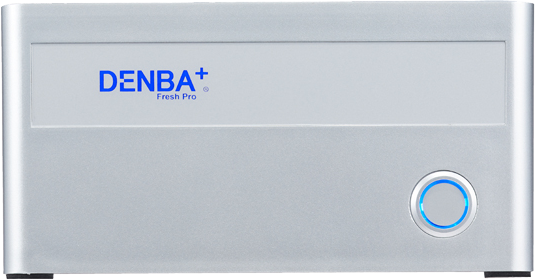
DENBA FreshPro
For commercial refrigerators and freezers
Pricing depends on your region
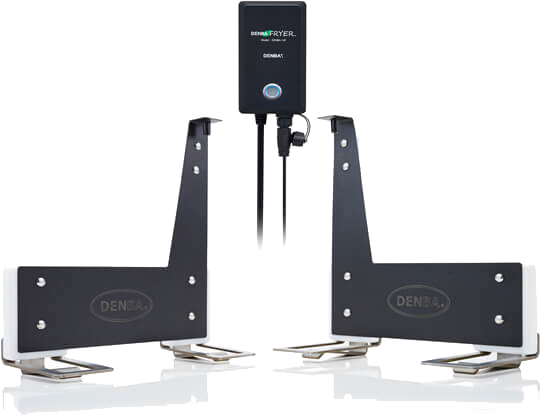
Discharge plates
Set of 3
Unit size
W200mm×D150mm×H100mm
Discharge plate size
W260mm×D170mm×H6mm
Application
Fits the commercial refrigerators used in restaurants, processing plants and central kitchens
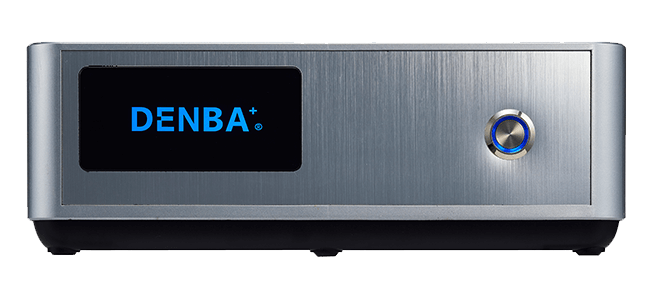
DENBA2.0
Large refrigerators and freezers, around 3.3 m²
Pricing depends on your region
Discharge sheets
Set of 3
Unit size
W300 x D200 x H108
Discharge plate size
W1260 x D660 x H10
Application
Retrofits into prefabricated cold rooms and warehouse-scale refrigerators. One set covers approx. 3.3 m².
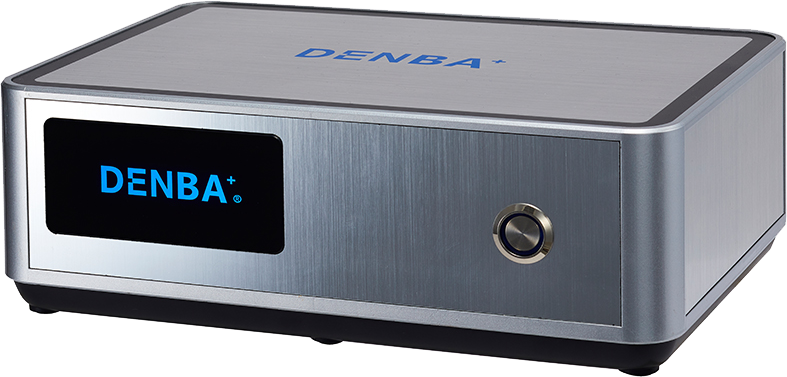
DENBA3.0
Large refrigerators and freezers, from 6.6 m²
Pricing depends on your region
Discharge sheets
Set of 6
Unit size
W360 x D230 x H113
Discharge plate size
W1260 x D660 x H10
Application
Retrofits into prefabricated cold rooms and warehouse-scale refrigerators. One set covers approx. 6.6 m².
See the DENBA effect on video
We run freshness trials with DENBA across a wide range of foods. Have a look.
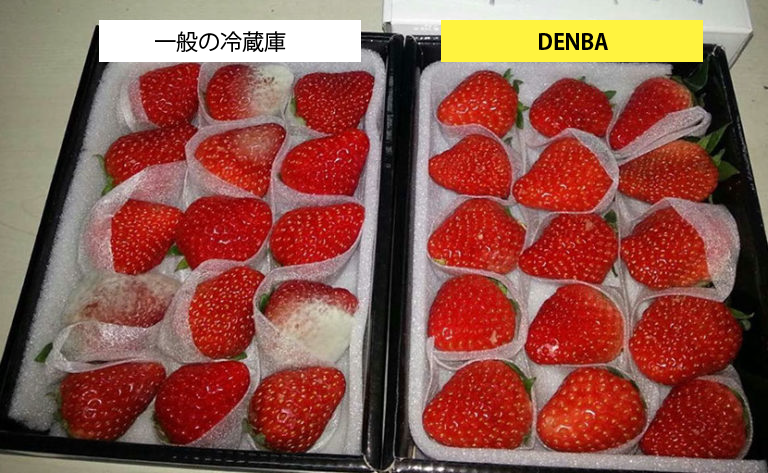
A freshness trial with strawberries
Trial period: two weeks, comparing a refrigerator fitted with DENBA against a conventional one. On the left is the conventional refrigerator: some of the strawberries have darkened and a few have developed white mould. On the right, with DENBA fitted, colour and firmness are close to how they went in, and the fruit is still perfectly good to eat. The difference is visible at a glance.
What sets DENBA apart from similar products
The question we are asked most often by people evaluating freshness-preservation equipment is simply: how is DENBA different from the alternatives?
For an operator who has not used one, the real worry is whether it will actually deliver. Paying a lot for equipment that then underperforms is an expensive mistake. (We offer a paid demo unit rental so you can see for yourself first.)
Freshness-preservation technology keeps advancing, and most products on the market reach a certain standard by one route or another. But because the underlying technologies differ, how you handle the food and how you use the equipment differ considerably.
Difference 1: safety
The most common approach on the market preserves freshness using high voltage, applied directly to the food. "High voltage" already sounds like something that needs careful handling.
And it is. Because the food itself is charged, touching it with wet hands mid-preparation can mean a shock, since the charge may still be there. DENBA runs at low voltage and carries PSE certification, so its safety is documented.
Difference 2: what it costs to install
Freshness-preservation equipment divides broadly into built-in and retrofit types.
Built-in means the technology is integrated into the refrigerator itself. Kitchen space is tight in most restaurants, so finding room for another unit becomes a problem in itself.
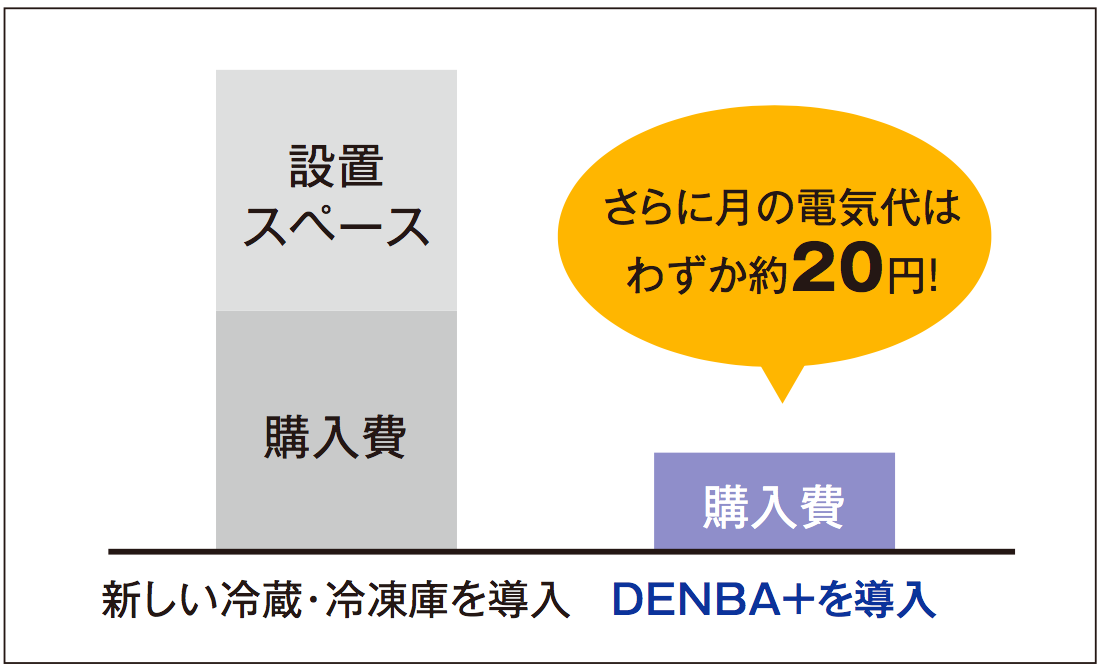
DENBA is a retrofit. It goes into the refrigerator or freezer you already have, which keeps the cost of adoption down - roughly one fifth to one eighth of a built-in solution. It is also flexible enough to go into large installations such as prefabricated cold rooms.
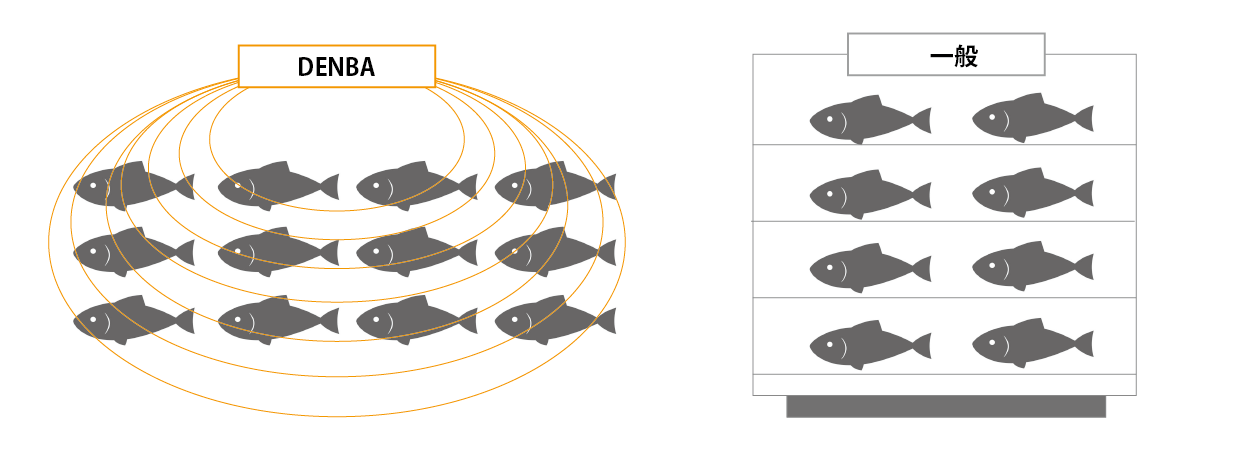
DENBA forms its field across the whole space.
Difference 3: what it costs to run
DENBA was built to change this industry, and there are a number of benefits to it. The one operators are happiest about is running cost.
High-voltage systems draw a lot of power, so the monthly electricity bill is inevitably high.
DENBA does not work by voltage. It resonates water molecules, and it uses almost no power - just 10 V, which works out at around 20 yen of electricity a month. The gap is not close.
| DENBA | Applies low voltage and low frequency to the food to preserve freshness, freeze and thaw. The field is formed across the whole space, so it adapts to many different installations. If you move premises, you can remove it and use it again. |
|---|---|
| Other products | Most competing products charge the food directly at 3,000-10,000 V to preserve, freeze and thaw. Comparable electric-field systems line the entire refrigerator interior with stainless plates, which makes any addition expensive - and relocation expensive too. |
| Capital cost | High | Low |
|---|---|---|
| Usable capacity | 15% less | Unchanged |
| Voltage applied to the food | 3000〜10000V | 10V |
| Safety | Lower | Higher PSE certified |

 info@denba.jp